
Tour of Rome
Piazza Navona
The Piazza Navona is situated west of the Pantheon in the historic centre of Rome. This is one of Rome's liveliest squares, with many outdoor cafes and restaurants. The square was constructed on what was the former Domitian's stadium, built by emperor Domitian in 86 AD. which has given the square its long oval shape. The stadium was paved over in the 15th century and the Piazza Navona was created. There still remains beneath the square, some remains of Domitian's stadium. Guided tours to this fascinating underground world are available, and start at the Piazza Tor Sanguigna 13. When you come to the Eternal City be sure to check out this beautiful Piazza.
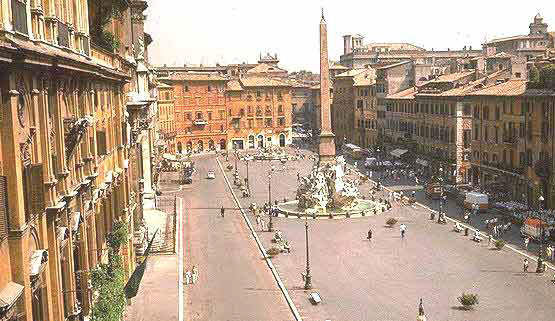
The Piazza Navona became a city market in the 15th century, and continued as such until the 1800's. It is common to find street vendors selling tourist souvenirs, and an abundance of artists offering to sketch you for a small fee. The square is a popular meeting place for both locals and visitors alike, and is a pleasant place to just sit with a drink in one of the cafes that face onto the square, and just watch the world go by, but be warned, as with many popular locations, prices here are well above the average.
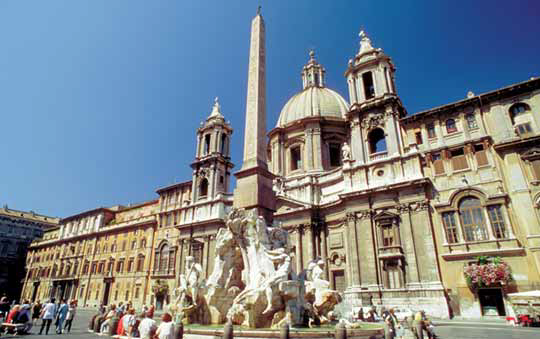
The church of Sant’Agnese in Agone which looks onto Piazza Navona, was originally the chapel of the Pamphili family, who lived in the building next door. It was built in the 17th century on a site that had been a place of worship dedicated to St Agnes, who was martyred in the piazza. Carlo Rainaldi started the construction, and was later succeeded by Borromini, who retained his predecessors interior designs, but modified the facade which were adorned with columns and the addition two bell towers. The interior is rich in statues, gilded stucco, frescoes, and marble altarpieces, all are works of Bernini's pupils.
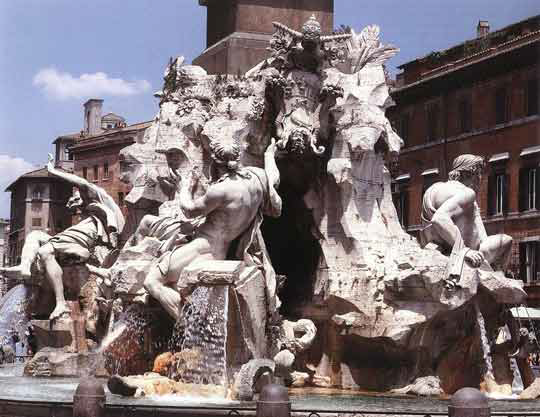
In the centre of the square can be found the largest of three fountains in the Piazza Navona, the Fontana dei Quattro Fiumi or Fountain of the Four Rivers. Constructed between 1647 and 1651, the design was first commissioned to Borromini, but was later taken over by Bernini. The fountain consists of four figures, representing the rivers, Nile, Ganges, Danube and Rio della Plata. The statues surround an obelisk that at one time was located at the Massenzio Circus. All three fountains in the Piazza Navona are fed by the Aqua Virgo aqueduct.
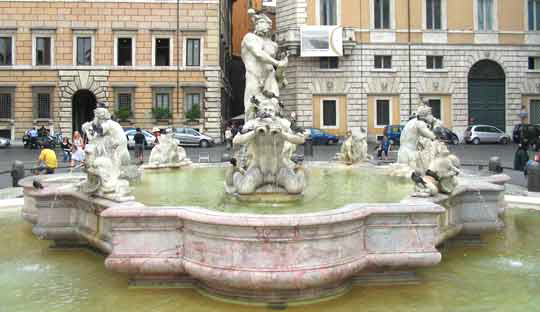
The Fontana Del Moro, or Moor Fountain, is located at the southern end of the Piazza Navona, and takes its name from the group of figures representing an Ethiopian fighting with a dolphin. The work was sculptured in 1654 to a Bernini design. The masks and sculptures of the tritons are copies of the originals which can now be seen in the gardens of the Villa Borghese.
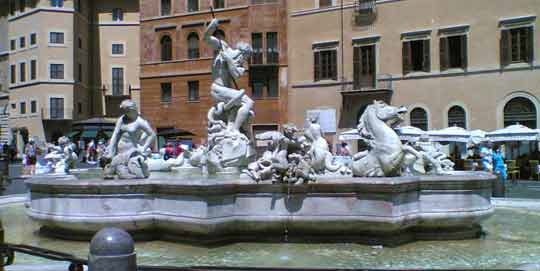
Fontana del Nettuno or Fountain of Neptune, is located at the northern end of the Piazza Navona. This fountain was commissioned to Giacomo della Porta in 1574, and as with the Fontana del Moro on the southern end, the material used was Portasanta, which is a rose marble. Della Porta's designed the two fountains to be similar in appearance, with tritons and large masks, but the project was never completed and for about 300 years the fountain remained undecorated. Without anything to identity the fountain, the local residents named it the Fontana dei Calderai or Fountain of the Coppersmiths. Finally in 1878, Antonio Della Bitta was commissioned to carve the statue of Neptune slaying a giant octopus, and Gregorio Zappala carved the group of 8 sea figures playing in the basin, two sea horses, two cherubs, two dolphins, and two Nereids or sea nymphs, and so the fountain was renamed, Fountain of Neptune.