Tour of Rome
Mamertine Prison
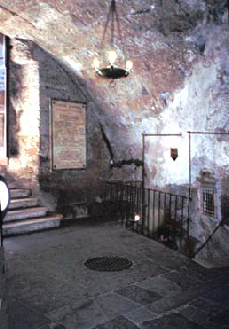
The Mamertine Prison, otherwise known as the Tullianum, is located on the east side of the Capitoline Hill, adjacent to the Roman Forum, and near the Arch of Septimius Severus, and below the church of San Giuseppe dei Falegnami. The prison consisted of two vaulted chambers, one above the other. The lower chamber is often referred to as the "Tullianum" as it is thought that the room was originally constructed to be a water cistern.
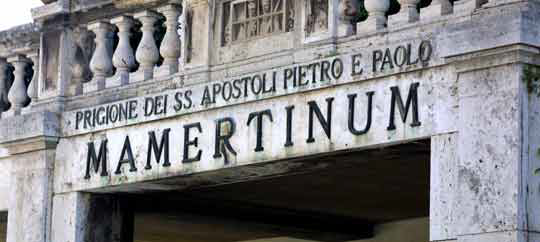
The name "Mamertine" originates from medieval times, probably to reinforce the claimed connection to the legends surrounding Saint Peter. The ancient Romans simply called the site "carcer", which is commonly translated to mean "prison". The "carcer" the only prison in the ancient city, and was reserved for important state prisoners, often prior to their execution.
The legend that Saint's Peter and Paul were imprisoned here seems to stem from the fifth century, although this does not exclude the fact that it may be true. It is possible that Paul could have been imprisoned here before he was executed at Aquas Salvias, and Peter before his execution in Nero's circus on the Vatican Hill. Paul wrote about his imprisonment several times in his letters, for an example see Philippians 1:13. The legend regarding the spring, where Saint Peter is supposed to have caused the spring to well up in the prison so enabling him to baptize his fellow prisoners, originated from much later times.
The upper room, which is on a level that was once the ground level of the prison in ancient times, is thought to date back to the second century B.C. The walls are made of blocks of tufa on which there is mounted a plaque on which are the names of the prisons most celebrated prisoners. At the back is a small alter with busts of both Saint Peter and Saint Paul. Originally access to the lower room was gained by throwing or lowering prisoners through a hole in the floor. Nowadays for safety reasons the hole is covered b a metal grate, with access to the lower floor being gained via a set of comparatively modern steps.
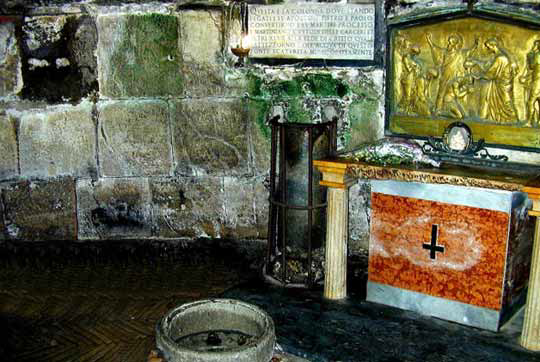
The circular lower room or Tullianum, is where the condemned prisoners were thrown and sometimes strangled. Here can be seen a small altar, backed with a relief of Saint Peter baptizing his fellow prisoners. On the front of the alter, standing out against a red marble background is the upside-